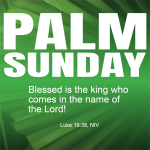


The word “holy” means “set apart”. The Christian Church calls this week “Holy Week” because it is the one week in the year specifically “set apart” to focus upon the week in which our Lord’s earthly redemptive mission reaches its fulfillment. It starts with Palm Sunday, includes Maundy Thursday and Good Friday, and reaches its climax on Easter Sunday.
Regarding Palm Sunday, Luke tells us “as (Jesus) was drawing near (to Jerusalem) – already on the way down the Mount of Olives – the whole multitude of his disciples began to rejoice and praise God with a loud voice for all the mighty works that they had seen, saying, ‘Blessed is the King who comes in the name of the Lord! Peace in heaven and glory in the highest!’”(Luke 19.37-38) While it is good to keep our eyes open to see the “mighty works” of Jesus in our world, there is also a red flag in this passage. The question is, are we still able to “rejoice and praise God” when we are not able to see any “mighty works” of God? As we well know, the most significant “mighty works” of God are often hidden in the cross.
While our focus on Maundy Thursday generally is upon our Lord instituting Holy Communion in the upper room, the term “maundy” has a totally different focus. Shortly after washing his disciples’ feet, and just before predicting Peter’s denials, Jesus says, “A new commandment I give you, that you love one another: just as I have loved you, you also are to love one another. By this all people will know that you are my disciples, if you have love for one another.” (John 13.34-35) The word “maundy” comes from the Latin manadatum, which means “command or mandate”. So, as you see, Maundy Thursday is more about our witness to the world than our Lord’s great gift to us in the Eucharist.
Paul gives us a great summary of Good Friday and Easter: “(Jesus) was delivered over to death for our trespasses and was raised for our justification.” (Romans 4.25) The Father delivered his dearly beloved Son over to the cross and hell to pay for our sins. And we know that the payment is sufficient because Jesus came back to life on Easter.
By the way, when in the Apostles Creed we confess that Jesus “descended into hell” we are not talking about Jesus being “delivered over to death for our trespasses”,as noted by its location in the Creed (“was crucified, died, and was buried. He descended into hell. The third day He rose again from the dead”). Jesus was damned to hell by the Father as he hung on the cross and cried out, “My God, my God, why have you forsaken me?” (Matthew 27.46) John, as he wraps up the scene at Golgotha, writes, “After this, Jesus, knowing that all was now finished, said (to fulfill the Scripture), ‘I thirst.’ … When Jesus had received the sour wine, he said, ‘It is finished,’ and he bowed his head and gave up his spirit.” (John 19.28, 30) If you want to read the Bible’s account of our Lord’s descent into hell, go to 1 Peter 3.18-19.
So much for Holy Week, except for drawing our attention to what this all means for you and me. Peter explains it this way, “Once we were not a people, but now we are God’s people; once we had not received mercy, but now we have received mercy. Thus we are a chosen race, a royal priesthood, a holy nation, a people for his own possession, that we may proclaim the excellencies of him who called us out of darkness into his marvelous light.” (1 Peter 2.10, 9) So, my friends, rejoice that by virtue of Holy Week (to which we are individually connected in our baptism – see Romans 6.4), you have seen set apart (made holy) not only to spend eternity with Jesus, but also to be his GOOD NEWS MESSENGERS to the world.
Happy Holy Week … and Holy Life!